Hoppers in Sri Lanka: The Complete Guide
If there is one dish that defines Sri Lankan eating, it is the hopper. Bowl-shaped, crisp at the edges, soft in the centre, made from fermented rice flour and coconut milk — an appa is one of the most pleasurable things you can eat for breakfast anywhere in the world. Most visitors to Sri Lanka encounter hoppers for the first time and are immediately converted.
This guide explains exactly what hoppers are, the different types you'll encounter, where to find the best versions, and how to eat them like a local.
What Are Hoppers?
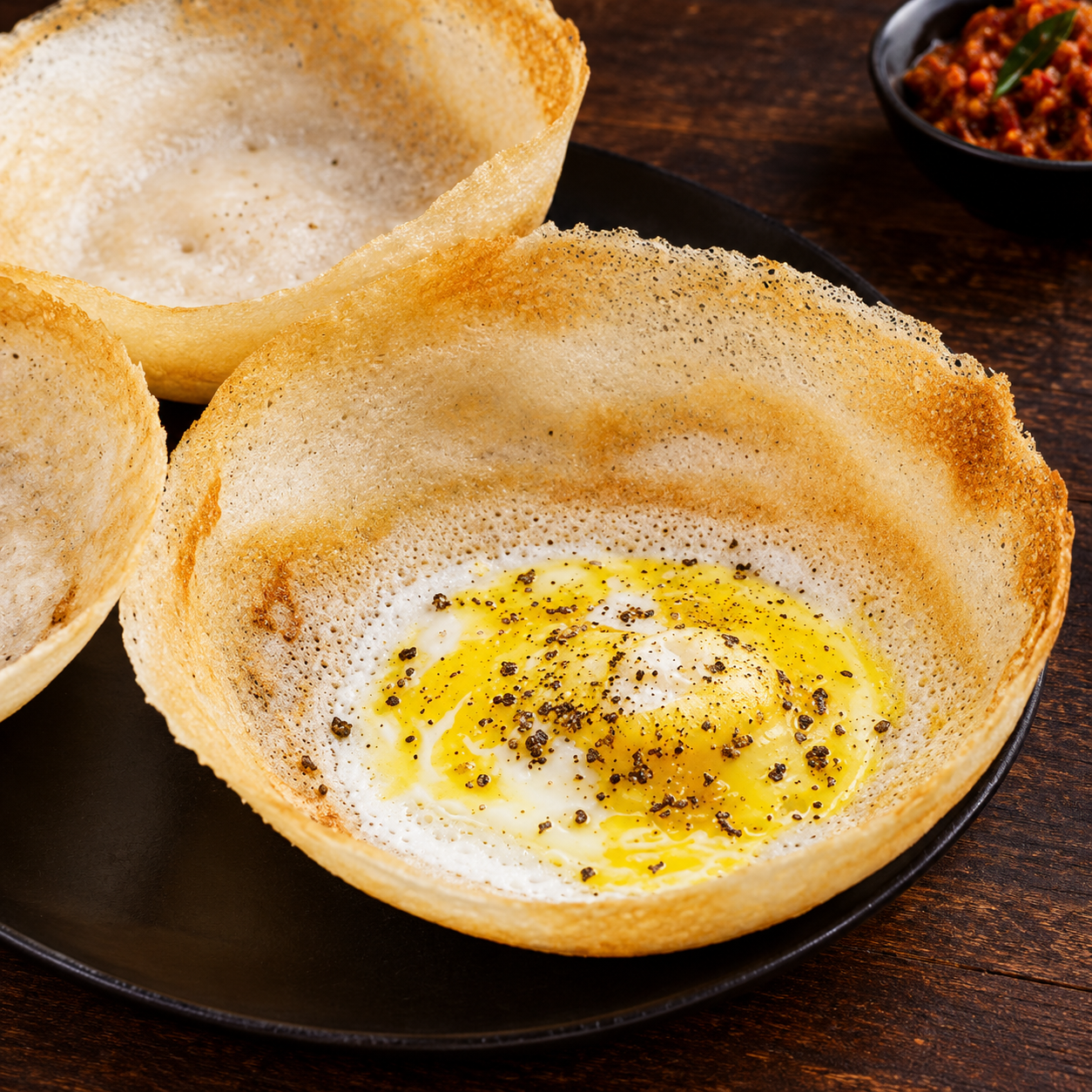
A hopper (appa in Sinhala, appam in Tamil) is a pancake made from a fermented batter of rice flour, coconut milk, sugar and a small amount of yeast or toddy (palm wine). The batter is poured into a small, round-bottomed iron wok, swirled to coat the sides, covered with a lid, and cooked over high heat for about three minutes. The result is a thin, lacy, slightly crisp bowl with a soft, almost custardy base — the fermentation gives the batter a subtle sourness that balances the richness of the coconut milk.
The technique of swirling the batter up the sides of the wok is what creates the hopper's characteristic bowl shape — thinner and crispier around the rim, thick and pillowy in the centre. A skilled hopper maker can produce twenty or thirty per hour; you'll see experienced cooks working multiple hopper pans at once in busy breakfast restaurants.
Types of Hoppers
Egg Hoppers
The most popular version in Sri Lanka and the one you should order first. An egg is cracked into the centre of the hopper partway through cooking, so it sets over the soft base. The yolk stays slightly runny (or fully set, if you prefer — ask for "well done"). You eat it by breaking off pieces of the crispy edge and scooping up egg and accompaniments.
Plain Hoppers
The basic version — no egg, just the batter. Simpler, slightly cheaper, and equally good when eaten with good accompaniments. Plain hoppers are often preferred for dipping into thick coconut milk.
Milk Hoppers
Coconut cream is poured into the centre before the lid goes on, creating a rich, almost dessert-like filling. Less common but worth seeking out — some restaurants make them only on weekends.
Sweet Hoppers (Kiri Appa)
Made with extra sugar and served with treacle (kithul palm syrup) and coconut milk, these are more breakfast sweet than savoury. An excellent way to finish a hopper meal.
String Hoppers (Idiyappam)
String hoppers are an entirely different thing to regular hoppers despite the shared name. They are made by pressing the same rice flour dough through a mould to create thin noodles, which are then steamed into circular noodle nests about 8cm in diameter. The result is delicate, slightly chewy, and almost neutral in flavour — a perfect vehicle for what you eat them with.
String hoppers are traditionally a morning or evening dish (rarely lunch), served with:
- Kiri hodi — a thin, fragrant coconut milk curry for dipping
- Pol sambol — freshly grated coconut with chilli and lime
- Dhal curry — a thick red lentil curry
- Seeni sambol — caramelised onion relish
You eat string hoppers by breaking them up with your fingers, mixing in the accompaniments, and eating with your right hand. Three or four string hoppers with kiri hodi is a deeply satisfying meal that costs about LKR 200–300 at a local restaurant.
Brown string hoppers (made from red rice flour) are nuttier and more filling than the standard white version and are worth trying if you see them on the menu.
What to Eat Hoppers With
The accompaniments are as important as the hopper itself. At a proper breakfast restaurant, a plate of two or three egg hoppers arrives with several small dishes on the side:
- Pol sambol — the essential: freshly grated coconut with dried chilli, onion, lime and Maldive fish. Made fresh every morning in good restaurants.
- Lunu miris — a chilli-onion sambol, intensely spiced, eaten in small amounts as a condiment.
- Seeni sambol — sweet caramelised onion relish, a milder counterpoint to lunu miris.
- Dhal curry — often served as a dipping sauce alongside hoppers.
- Coconut milk — fresh, thin, slightly sweet; poured over the egg hopper and eaten with pol sambol.
The combination of crisp hopper edge, runny egg, creamy coconut milk and the heat of pol sambol eaten together is one of the great breakfast experiences in Asia. Do not rush it.
When Are Hoppers Served?
Hoppers are primarily a breakfast and dinner dish — you will almost never find them at lunch. This is tied to the fermentation: the batter needs several hours to develop its flavour and the right consistency, so it is prepared the previous evening for morning service and fresh in the afternoon for dinner service. Many dedicated hopper restaurants open only at breakfast (from 6–7am until around 11am) and dinner (from 6pm onwards).
If you arrive at a restaurant at noon and ask for hoppers, you will almost certainly be told they are finished. Plan accordingly.
Where to Find the Best Hoppers in Sri Lanka
Local breakfast restaurants and bakeries: The most reliable source. Every town in Sri Lanka has at least one restaurant that serves hoppers in the morning. Look for a simple place with a queue of local customers at 7am.
Colombo: The capital has dedicated hopper specialists — look around Borella, Wellawatte and Pettah for authentic local spots. Galle Face Green's evening food stalls also serve hoppers.
Kandy: The market area around the Kandy bus station has excellent breakfast spots serving string hoppers and egg hoppers from 6am.
Galle: The town centre (beyond the Fort tourist area) has local restaurants where hoppers cost LKR 40–60 each. The Fort area restaurants serve them too but at three to four times the price.
Ella: A smaller town with good hopper options — the restaurants on the main road near the Ella Rock trailhead are good value and serve tourists and locals alike.
How Much Do Hoppers Cost?
At a local Sri Lankan restaurant, hoppers cost LKR 40–80 each for plain or egg hoppers, with accompaniments usually included or charged separately at LKR 50–100. A breakfast of two egg hoppers with pol sambol and tea costs around LKR 200–350 (approximately USD 0.70–1.20 at current exchange rates).
At tourist-facing restaurants in Galle Fort, Mirissa or Ella, the same meal costs LKR 600–1,200. The food is often good — but the difference is substantial enough that it's worth finding the local alternative at least once.
How to Make Hoppers at Home
The main challenge with making hoppers at home is the fermentation and the specialist pan. Hopper pans (small, round-bottomed iron woks with a lid) are available in Sri Lankan grocery shops internationally. The batter — rice flour, coconut milk, a little yeast, sugar and salt — needs 6–8 hours to ferment before it's ready. The cooking technique takes a little practice to get the swirl right.
A cooking class in Sri Lanka is the best way to learn — you'll pick up the swirling technique from someone who has done it thousands of times, and you'll leave with a recipe you can actually replicate.
Sri Lanka Cooking Classes
Learn to make hoppers, kottu roti and rice and curry with a hands-on cooking class. Most include a market visit and a full sit-down meal at the end.
Find Cooking ClassesThis post contains affiliate links. We earn a small commission at no extra cost to you.
Quick Reference
| Type | Description | Price (local restaurant) |
|---|---|---|
| Egg hopper | Hopper with egg set in the centre | LKR 50–80 |
| Plain hopper | Hopper without egg | LKR 40–60 |
| Milk hopper | Hopper with coconut cream filling | LKR 60–100 |
| String hopper (white) | Steamed noodle nest, plain | LKR 30–50 |
| String hopper (brown) | Steamed noodle nest, red rice flour | LKR 35–60 |
The best hopper experience in Sri Lanka is often the simplest one: a plate of two egg hoppers, fresh pol sambol, a small bowl of dhal, and a cup of very strong, sweet tea, eaten at a basic local restaurant at 7 in the morning while the town wakes up around you.