Ceylon Tea: The Complete Guide
Sri Lanka is one of the world's great tea-producing nations — and visiting the hill country to see, smell and taste it at source is one of the most satisfying travel experiences the island offers. The emerald-green terraces of the central highlands, the smell of drying tea leaves carried on the cool morning air, and a cup of freshly brewed Ceylon orange pekoe at a plantation guesthouse are among the images that define travelling in Sri Lanka for many visitors.
Ceylon tea — the name refers to the island's former name under British rule — is a distinct category of black tea known globally for its brightness, clarity and a flavour profile that ranges from the light, delicate teas of Nuwara Eliya to the bold, full-bodied teas of Ruhuna in the south. This guide covers everything you need to know about tea in Sri Lanka, from the regions and grades to where to go and how to drink it properly.
A Brief History of Ceylon Tea
Tea was introduced to Sri Lanka in the 1860s by British planters, initially as a replacement for the coffee plantations that had been destroyed by a fungal blight. James Taylor, a Scottish planter, established the first commercial tea estate at Loolecondera in the Kandy district in 1867 — the estate still exists and can be visited. Within two decades, tea had transformed the Sri Lankan economy and landscape: by the 1880s, hundreds of thousands of acres of hill country had been converted to tea cultivation, and the industry continues to dominate the central highlands today.
The tea pickers who work the estates — predominantly Tamil women from families that have worked the plantations for five or six generations — are one of the most visible and culturally important communities in the hill country. Their wages and living conditions have been the subject of longstanding concern; choosing tea from ethically certified estates (look for Rainforest Alliance or Fair Trade certification) is one direct way to support better conditions.
The Tea Regions
Sri Lanka's tea is classified primarily by elevation — high-grown (above 1,200m), mid-grown (600–1,200m) and low-grown (below 600m). The flavour profiles are distinctly different:
Nuwara Eliya (High-Grown)
At 1,868m, Nuwara Eliya is the highest and coolest of Sri Lanka's tea regions — Sri Lanka's closest equivalent to Darjeeling. The cold nights and misty conditions produce tea that is light in colour, delicate in body and distinctively fragrant — often described as having a floral or "minty" character. Nuwara Eliya teas are the most prized for single-origin brewing and tend to be more expensive. The town itself is charming — a slightly strange colonial hill station with bungalows, a horse racing track and roses in every garden.
Dimbula (High-Grown)
West of Nuwara Eliya, Dimbula produces teas that are brighter and more brisk than those from further east — a classic Ceylon flavour profile that is particularly well-suited to drinking with milk. The best Dimbula teas have a clean, slightly astringent quality with a bright amber colour.
Uva (High-Grown)
The eastern slopes of the central highlands, facing the dry zone plains, produce the Uva teas — known for a characteristic slightly medicinal flavour (described as "menthol" or "camphoraceous") that makes them prized for blending. The best Uva teas are made during July–September when the dry Cachan wind concentrates the flavour compounds. The Ella and Haputale areas fall within the broader Uva region.
Kandy (Mid-Grown)
The mid-grown teas of the Kandy area are fuller-bodied than the high-grown teas, with a darker colour and less delicate flavour — excellent for blending and everyday drinking. The tea you drink in most Sri Lankan teashops is mid-grown or a blend including mid-grown tea.
Ruhuna (Low-Grown)
The south of Sri Lanka — particularly the Matara and Hambantota districts — produces low-grown teas that are dark, bold and full-bodied with a strong malty flavour. Ruhuna teas are the base for the thick, sweet "plain tea" drunk by most Sri Lankans in the morning and evening.
Understanding Tea Grades
Ceylon tea is graded by leaf size, with smaller particles producing stronger, faster-brewing tea:
- FBOP (Flowery Broken Orange Pekoe) — high quality broken leaf tea with golden tips
- BOP (Broken Orange Pekoe) — the standard grade for most quality teabags and loose tea
- BOPF (Broken Orange Pekoe Fannings) — smaller particles, used in teabags for very fast brewing
- Dust — the smallest grade, used in budget teabags; strong but less flavourful
- OP (Orange Pekoe) — whole leaf tea with a lighter, more delicate brew
- Pekoe — a grade of small whole leaves
- Silver Tips / White Tea — the least processed, made from the silver-haired new buds; very delicate and expensive
For brewing at home, BOP or FBOP loose leaf tea from a reputable estate is the best all-purpose choice. For gifts, look for whole-leaf OP from Nuwara Eliya or silver tips from a highland estate.
How Sri Lankans Drink Tea
The way tea is consumed in Sri Lanka has very little in common with the way it is packaged for export. The tea you get at a roadside teashop (kade) is a small glass — sometimes a cup, more often a thick glass tumbler — of extremely strong, dark tea that has been brewed for five to ten minutes until it is almost black, then diluted with a significant amount of condensed milk and sugar. The result is sweet, very strong, and very cheap (LKR 40–80). This is the tea that fuels Sri Lankan daily life.
"Plain tea" means black tea with sugar, no milk. "Milk tea" is the default with condensed milk. If you want tea brewed with fresh milk (as in the UK), you will need to ask specifically and it may not be available at a simple kade.
The best tea in Sri Lanka is not in a tourist hotel or a fancy plantation café — it is from the simplest roadside teashop, where the tea is freshly made, the glass is hot, and the whole transaction takes about thirty seconds. Drink it standing at the counter. Order a bun or short eat to go with it. It will cost you LKR 100–150 and will be better than almost anything you've had at home.
Where to Visit in Sri Lanka's Tea Country
Nuwara Eliya
The most visited tea region and the most accessible from Ella and Kandy. The Mackwoods Labookellie estate on the A5 road between Kandy and Nuwara Eliya offers free factory tours and tea tasting — it is the most tourist-visited estate in the country and the factory tour is worthwhile. Pedro Estate in Nuwara Eliya town offers a more in-depth tour. The town itself is worth exploring for its colonial architecture, the Gregory Lake, and the produce market.
Haputale and the Dambatenne Estate
Haputale is a small, dramatically situated hill town on the edge of the escarpment — the views from the Lipton's Seat viewpoint (a hike or tuk-tuk ride from town) are among the finest in Sri Lanka. The Dambatenne Tea Factory, built by Thomas Lipton in 1890, offers tours of the original factory machinery. The town is less touristy than Ella and has a more authentic feel.
Ella
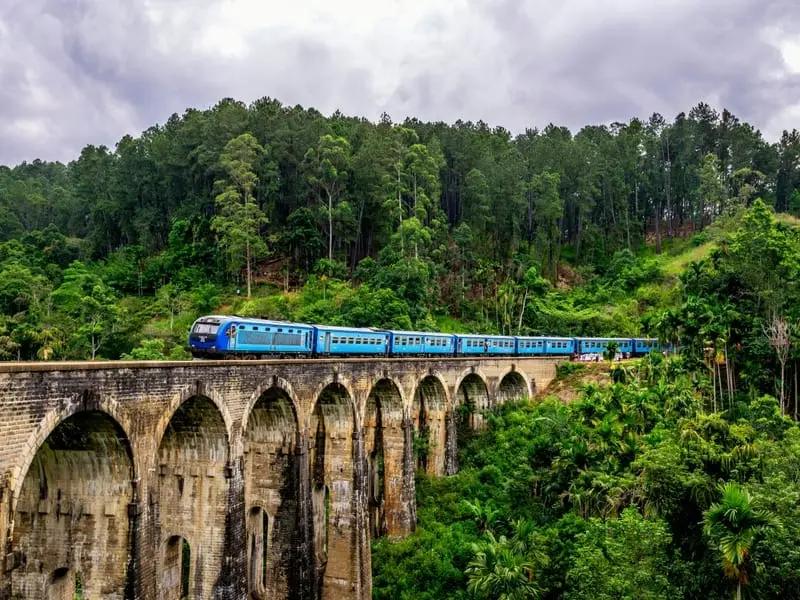
Ella is surrounded by tea estates and the walk from town through the tea fields towards Little Adam's Peak passes through working plantations. Several small estates near Ella offer informal tours. The view from the Nine Arch Bridge, framed by tea fields, is one of the most photographed images of Sri Lanka.
Tea Plantation Tours
Visit a working tea estate with a guided tour — see the plucking, processing and tasting, and take home Sri Lanka's finest teas.
Find Tea ToursThis post contains affiliate links. We earn a small commission at no extra cost to you.
What to Buy: Tea as a Gift
Ceylon tea is one of the most universally appreciated gifts you can bring home from Sri Lanka. For quality loose-leaf tea, the best shops are directly at the estates (Mackwoods, Pedro, Dambatenne) or at specialist tea merchants in Colombo. The Dilmah factory shop in Colombo sells the full range at factory prices. Avoid buying tea from tourist shops in Ella or Galle Fort — the quality is inconsistent and the prices inflated.
What to look for: estate-specific tea from a named region (Nuwara Eliya, Dimbula, or Uva), packed in a foil-sealed bag to preserve freshness. For gifts, presentation tins from Mackwoods, Mlesna or Dilmah are widely available and travel well. For your own drinking, 200–500g of loose-leaf BOP from a Nuwara Eliya estate is the single best thing you can bring home.
The Tea Train: Kandy to Ella
The train journey from Kandy through Nuwara Eliya to Ella — passing through the heart of Sri Lanka's tea country — is consistently voted one of the most scenic train journeys in the world. The route climbs through mist-shrouded highlands, past emerald tea terraces, through tunnels and over bridges that offer vertiginous views of the surrounding valleys. The journey from Kandy to Ella takes approximately 7 hours on the slow train (the most scenic option) or 5 hours on the intercity express. Book early: the observation car seats sell out weeks in advance during peak season.
A cup of tea from the train vendor — strong, sweet, served in a small cup — drunk while watching the tea fields pass outside the window is one of those small travel experiences that turns out to be entirely as good as it sounds.