The Best Waterfalls in Sri Lanka
Sri Lanka's hill country is a land of waterfalls. The wet zone escarpment — where moisture-laden southwest monsoon winds rise against the central massif and release their load — produces some of the finest cascades in Asia. From Sri Lanka's tallest waterfall at 263 metres to the Diyaluma natural rock pools that travellers wade hours to reach, here are the waterfalls genuinely worth your time.
Timing note: most waterfalls are at their most spectacular in the weeks immediately after the monsoon rains — October through December for the south-facing escarpment, and May–June for the north-facing slopes. Visit too late in the dry season and some falls reduce to a trickle.
1. Diyaluma Falls — Sri Lanka's Most Rewarding Waterfall
Height: 220 metres (2nd highest in Sri Lanka) | Near: Koslanda, 30km from Ella | Swimming: Yes — spectacular natural pools at the top
Diyaluma is the waterfall that justifies the whole journey. A single dramatic curtain of white water drops 220 metres over a sheer cliff face into a deep plunge pool below. But the real experience is at the top — reached via a 45-minute scramble up the left side of the falls, the top of Diyaluma reveals a series of gorgeous natural rock pools carved smooth by centuries of flowing water, sitting on the edge of a cliff with views across the valley. Swimming here, with your feet dangling over the edge, is one of Sri Lanka's finest experiences.
The pools are best visited late morning (arrive by 9am to beat the midday heat for the climb). Wear shoes with grip — the trail is steep and the rocks wet. Take your own water and snacks. The cascade itself is visible from the road (A4 highway, Koslanda section) and photogenic at any time of day, though side-lit in the late afternoon.
The nearest bases are Ella (30km, 45 min) or Haputale (18km, 30 min). Tuk-tuk or private car recommended — public buses stop on the road but the trail head requires local knowledge.
2. Ravana Falls — The Most Accessible Waterfall in Sri Lanka
Height: 25 metres | Near: Ella town (3km) | Swimming: In the plunge pool, yes
Ravana Falls sits directly beside the A23 road between Ella and Wellawaya — you can see it from the bus window. This accessibility is both its strength and weakness: it's the most visited waterfall in Sri Lanka, which means vendors, crowds and persistent touts in high season. Get there before 8am and you may have it largely to yourself.
The falls are wide and photogenic, flowing in multiple channels down a moss-covered rock face. According to the Ramayana, this is the cave where the demon king Ravana hid Sita — hence the name. A small cave system behind the main falls is viewable with a short scramble. The plunge pool at the base is swimmable.
From Ella, a tuk-tuk costs about LKR 400–600 return (including waiting time). It pairs naturally with a visit to Diyaluma — both are on the same road.
3. Bambarakanda Falls — Sri Lanka's Tallest Waterfall
Height: 263 metres (tallest in Sri Lanka) | Near: Haputale (18km) | Swimming: No
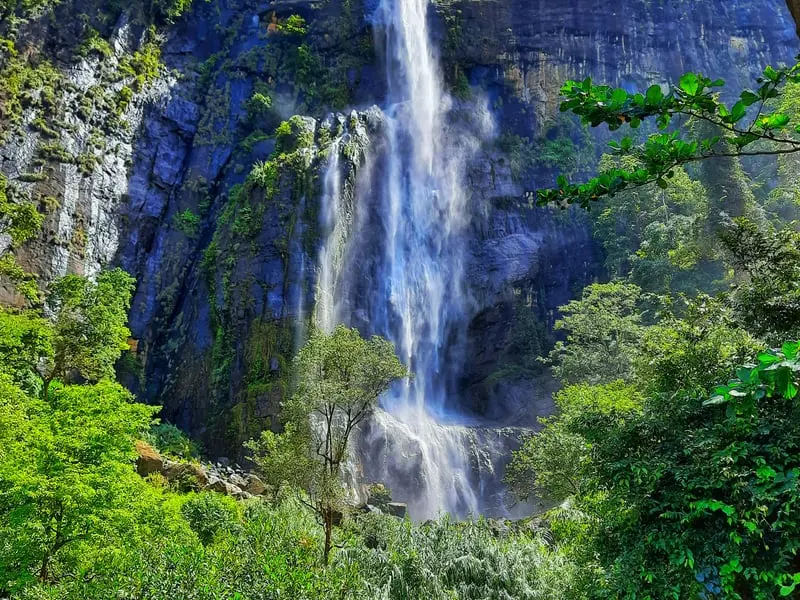
Sri Lanka's tallest waterfall is also its least known among tourists. Bambarakanda drops 263 metres in a single free-falling plume, visible from the Beragala-Koslanda road that connects Haputale to Wellawaya. The best viewpoint is from the road itself — there's no substantial trail to the base. In the dry season, the falls reduce significantly; after heavy rain, they are spectacular. Best photographed in the morning light. The drive from Haputale through the tea estates takes about 30 minutes on winding mountain roads.
4. Devon and St Clair Falls — Tea Estate Waterfalls
Height: Devon 97m, St Clair 80m | Near: Hatton / Nuwara Eliya (20km) | Swimming: No
Devon Falls and St Clair Falls sit within a few kilometres of each other on the Hatton-Nuwara Eliya road, both visible from the road as you drive through tea estates. They are often called "the twin falls" though they're not actually adjacent. Devon has a particularly elegant drop — a wide curtain over a dark basalt cliff, framed by green tea bushes. Both carry English colonial names from the 19th-century estate era. Best photographed in the soft light of early morning. Stop at the Devon viewpoint first, then continue to St Clair before heading on to Nuwara Eliya.
5. Baker's Falls — The Forest Waterfall at Horton Plains
Height: 20 metres | Near: Horton Plains | Swimming: No (inside national park)
Baker's Falls is the scenic highlight of the Horton Plains World's End walk. After the drama of the World's End cliff viewpoint, the trail loops back through montane cloud forest before descending to this beautiful waterfall — a wide, 20-metre cascade into a clear pool, surrounded by dense jungle. The ambient silence is broken only by endemic birds and the water's roar. Named after Samuel Baker, the Victorian explorer and elephant hunter. Visit early morning (park opens at 6am) for the best light and to beat the mist that often rolls in by 10am. The full World's End + Baker's Falls loop is 9.5km and takes 3–4 hours.
6. Bopath Ella — The Fig-Leaf Waterfall Near Ratnapura
Height: 30 metres | Near: Ratnapura (3km) | Swimming: Yes — pool at the base
Bopath Ella's unusual shape — the water fans out as it falls, resembling a Bo tree leaf (hence "bopath") — makes it one of Sri Lanka's most distinctive waterfalls. A swimmable pool lies at the base. It's a 15-minute walk from the road on a good trail. Very few tourists make it here (most are gem-shopping in Ratnapura), which means you often have the pool to yourself. Best after rain. Combine with a Ratnapura gem market visit for a full afternoon.
7. Dunhinda Falls — Badulla's Most Spectacular Cascade
Height: 64 metres | Near: Badulla (5km) | Swimming: Yes
Dunhinda is one of the wider falls in Sri Lanka, with a powerful flow that generates considerable mist. The trail from the road to the viewpoint takes about 25 minutes through forest, crossing a suspension bridge over the Badulu Oya. The area around the falls is permanently damp from spray. After heavy rain, Dunhinda is genuinely dramatic — the volume of water is impressive and the roar can be heard from 500 metres. Badulla is the end of the scenic railway line from Kandy (via Ella), making this a natural addition to a highland rail journey.
8. Laxapana Falls — Power Station Waterfall
Height: 126 metres | Near: Hatton (15km) | Swimming: No
Laxapana Falls feeds the Laxapana Power Station — one of Sri Lanka's main hydroelectric facilities — and can be viewed from a dedicated viewpoint on the road between Hatton and Maskeliya. The reservoir at the base gives it a distinctive setting. A tall, elegant single drop. Best visited in the morning. Accessible as a stop on the road to Adam's Peak.
Stay in Ella — Sri Lanka's Waterfall Capital
Ella is the best base for the hill country's waterfalls — within 45 minutes of Diyaluma, Ravana Falls, Baker's Falls and Dunhinda.
Find Hotels in EllaThis post contains affiliate links. We earn a small commission at no extra cost to you.
Tips for Visiting Sri Lanka's Waterfalls
- Best after the monsoon: Visit in October–December (for the south) or May–June (for the north). Dry season (January–April) can reduce some falls to trickles.
- Footwear: Wear shoes with grip for any waterfall with a trail (Diyaluma especially). Flip flops are dangerous on wet rocks.
- Get there early: Most popular falls (Ravana, Diyaluma roadside) are crowded from 9am. Sunrise visits are quieter.
- Swimming safety: After heavy rain, currents in plunge pools can be surprisingly strong. Read local conditions.
- Combined trips: Diyaluma + Ravana Falls (both on the A4 between Ella and Ratnapura), Devon + St Clair (Hatton area), Baker's Falls within the Horton Plains walk.