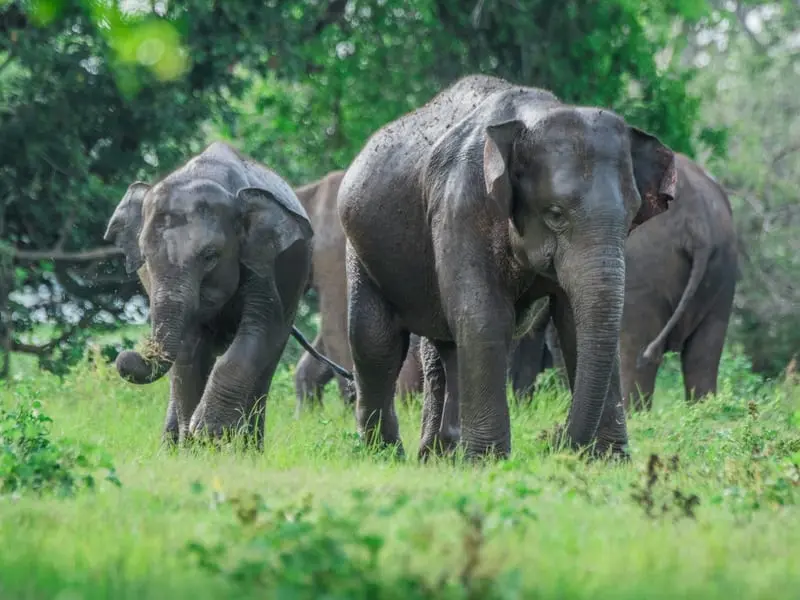
Sri Lanka packs an extraordinary density of wildlife into a small island. Despite being roughly the size of Ireland, it hosts leopards, elephants, sloth bears, blue whales, sperm whales, five species of marine turtle and over 400 bird species — including 33 species found nowhere else on earth. The national park system protects roughly 14% of the island's land area, and the best parks are genuinely world-class safari destinations that rank alongside far more famous East African reserves for specific experiences. This guide covers the six parks worth a dedicated visit, ranked by experience quality.
1. Yala National Park — Best for Leopard Sightings
Yala is the most visited national park in Sri Lanka, and for one dominant reason: it has the highest density of leopards of any national park in the world. Block 1, the most accessible section of the park, sees leopard sightings on most morning game drives — on a typical 3-hour safari you have a realistic 70–80% chance of seeing a leopard, which is simply extraordinary by any global standard. Beyond leopards, Yala holds elephants (120–150 individuals in Block 1), sloth bears, water buffaloes, crocodiles, jackals and over 200 bird species. The landscape is a dramatic mix of scrub jungle, rocky outcrops, lagoons and a long coastline that makes for beautiful photography at dawn and dusk. The main entrance at Palatupana is 280km from Colombo (5 hours) or 95km east of Tangalle (2 hours) — positioning Yala naturally at the end of a south coast road trip. Game drives run morning (5:30am–10am) and evening (3pm–6:30pm); morning gives better cat activity. Entry and jeep hire runs USD 25–35 per person for the park fees plus LKR 5,000–7,000 for a jeep. Book jeeps and drivers in advance between November and April.
Best time: February–July (dry season, animals concentrate near water). The park closes in September for maintenance. Stay at: Tissamaharama town for budget options; there are excellent luxury lodges just outside the park boundary.
Book a Yala Safari
Half-day and full-day Yala safari jeep tours with an expert guide. Best leopard sighting rates in February–July.
Find Yala Safari ToursThis post contains affiliate links. We earn a small commission at no extra cost to you.
2. Udawalawe National Park — Best for Elephant Herds
Udawalawe is the park to visit if your primary goal is seeing large herds of wild elephants in the open. The park occupies 30,821 hectares of dry grassland surrounding the Udawalawe Reservoir — an environment that provides almost no forest cover for elephants to hide in, meaning you see them in the open throughout the day, not just at dawn. Udawalawe has a resident elephant population of around 700 animals — entire family groups with calves, teenagers, bulls in musth, matriarchs. You'll typically see 30–80 elephants per game drive. There are few other large predators, which makes Udawalawe feel relaxed compared to Yala — no tensed-up jeep convoys circling a leopard sighting, just open grassland, elephants and sky. Elephants aside, the park is excellent for water buffalo, crocodile, monitor lizard and birds (particularly raptors). Udawalawe is also home to the Udawalawe Elephant Transit Home, a rehabilitation centre that returns orphaned elephants to the wild — public feeding visits run at 9am and 3pm daily.
Best time: Year-round; dry season (May–September) concentrates animals at the reservoir. Getting there: 165km from Colombo (3.5 hours), 80km from Tangalle, 60km from Ella via the mountain route.
3. Wilpattu National Park — Best for Atmosphere & Solitude
Wilpattu is Sri Lanka's largest national park (131,693 hectares) and its most atmospheric. The landscape — a network of natural circular lakes called villus (shallow basin lakes fed by rainwater) set in dense dry forest — is unique in Asia and unlike any other park in the country. Leopards, sloth bears, elephants and spotted deer are all present, and the park holds one of the highest leopard densities outside Yala. What sets Wilpattu apart is the near-total absence of visitor crowds: visitor numbers are roughly a tenth of Yala's, meaning you can drive for hours seeing no other jeep. If you want the experience of being alone in an ancient forest with large wildlife, Wilpattu delivers this better than anywhere else in Sri Lanka. The park is 170km north of Colombo near Puttalam — slightly off the main tourist trail, which is precisely why it feels so unspoiled. Road conditions inside the park can be rough in the wet season.
Best time: February–October (dry season). The park partially closes during the northeast monsoon (November–January). Getting there: 170km north of Colombo (3 hours via highway), 70km north of Anuradhapura.
4. Minneriya National Park — Best for the Elephant Gathering
Minneriya is a single-purpose pilgrimage for one of the natural world's great spectacles: the Gathering. Between July and October, as the dry season lowers the water level in the massive Minneriya Tank (an ancient reservoir covering 8,800 acres), hundreds of elephants converge from the surrounding forests to graze on the fresh grass exposed along the tank's retreating shoreline. At the peak in August–September, up to 300 or more elephants can be visible simultaneously — one of the largest concentrations of wild Asian elephants on earth. The sight of great elephant herds stretching across the tank's mud flats under a vast open sky, with calves tumbling in the shallows and bulls sparring in the distance, is one of the travel experiences in Asia. Outside the Gathering season, the park holds elephants year-round and has good birdlife around the tank, but the main draw is the July–October window. Minneriya is 185km from Colombo (3.5 hours) and is ideally placed to combine with a Cultural Triangle visit — Sigiriya is just 22km away.
Best time: July–September (peak Gathering). Elephant numbers drop significantly outside this window. Combined with: Sigiriya, Polonnaruwa, Habarana area.
5. Bundala National Park — Best for Birdwatching
Bundala is the park for serious birders. A Ramsar-designated wetland on Sri Lanka's south coast, Bundala's brackish lagoons, mudflats, dry forest and salt pans create a remarkable habitat mosaic that draws both endemic species and migratory visitors — over 200 bird species have been recorded. Between September and March, Bundala hosts thousands of flamingos, making the lagoon edges glow pink at dawn. Greater and lesser flamingos; painted storks; spoonbills; pelicans; pratincoles; over 30 species of wader; five species of kingfisher. Mammals are present (elephants use the park seasonally, crocodile and water buffalo inhabit the lagoons) but birds are the main event. The park is small and easy to cover in a half-day by jeep. It sits 35km west of Tissamaharama, making it a natural pairing with a Yala safari: an afternoon at Bundala followed by an early Yala morning drive covers both park types efficiently.
Best time: September–March (peak migratory season and flamingo numbers). Combined with: Yala National Park, Tissamaharama.
6. Sinharaja Forest Reserve — Best for Endemic Birds & Rainforest
Sinharaja is not a classic game-drive park — there are no jeep safaris, no leopards, no elephants. It is Sri Lanka's last remaining lowland tropical rainforest, a UNESCO World Heritage Site, and arguably the finest birding destination in South Asia. Of the 33 bird species endemic to Sri Lanka, 26 have been recorded in Sinharaja. The forest is extraordinary in its biological richness: ancient dipterocarp trees, endemic plants, massive land snails, jumping pit vipers and the daily passage of mixed-species bird flocks that are the forest's defining wildlife experience. Walking with a local guide who knows the forest means you encounter dozens of species in a single morning — blue magpie, red-faced malkoha, green-billed coucal, crested drongo, brown-capped babbler and the rare Sri Lanka broad-billed roller. The Kudawa entrance (35km from Ratnapura) is the main access point; guides are mandatory and available at the entrance (LKR 2,500–3,500 per group). Sinharaja receives high rainfall year-round but is somewhat less wet between December and April and June–August.
Best time: December–April and June–August (drier windows). Getting there: 35km south of Ratnapura, 150km from Colombo.
Quick Comparison: Which Park Should You Visit?
| Park | Best For | Best Months | From Colombo |
|---|---|---|---|
| Yala | Leopards | Feb–Jul | 280km / 5hr |
| Udawalawe | Elephant herds | Year-round | 165km / 3.5hr |
| Wilpattu | Solitude, bears | Feb–Oct | 170km / 3hr |
| Minneriya | Elephant Gathering | Jul–Sep | 185km / 3.5hr |
| Bundala | Birdwatching | Sep–Mar | 245km / 4.5hr |
| Sinharaja | Endemic birds | Dec–Apr | 150km / 3hr |
Safari Planning Tips
Book jeeps in advance between November and April (peak season) — jeeps at popular parks like Yala sell out by the night before. Walk-up morning availability is unreliable in high season. The best approach is to book a package that includes accommodation and the jeep together, as lodge guesthouses manage their own jeep allocation.
Arrive before dawn. The gate opens at 5:30am. The first two hours of daylight are when predators are active, birds are calling and light is best for photography. Arriving at 7am means the best is already over — the animals that were on the move at 5:30am are now resting in shade.
Expect crowds at Yala during school holiday periods. In January and August, Block 1 can have 200+ jeeps chasing the same leopard sighting. Wilpattu avoids this entirely; Udawalawe is less crowded than Yala but still busy in peak season.
Combine parks efficiently. Yala + Udawalawe + Bundala can be covered in 3 days based from Tissamaharama. Wilpattu pairs naturally with Anuradhapura (2 days). Minneriya sits in the Cultural Triangle. Sinharaja is a day trip from Ratnapura.