Quick Facts
- Province
- Central Province
- UNESCO
- World Heritage Site
- Founded
- 1st century BC
- Caves
- 5 temples
- Statues
- 157 Buddhas
- Entry Fee
- ~USD 15
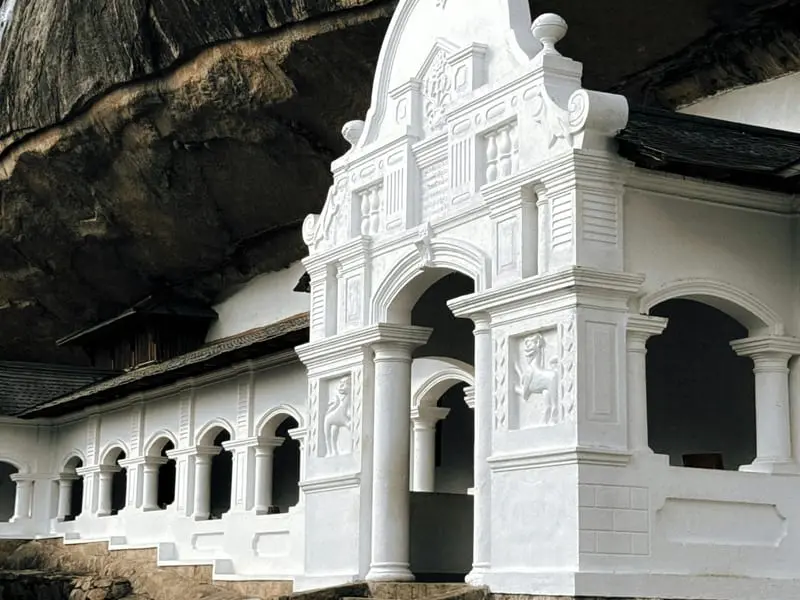
The Dambulla Cave Temple — officially the Golden Temple of Dambulla — is one of the most spectacular religious sites in Sri Lanka and one of the finest cave temple complexes in Asia. Carved into a massive granite outcrop rising 160 metres above the surrounding plain, the five cave temples contain the largest collection of ancient cave paintings in Sri Lanka and 157 statues of the Buddha spanning 2,000 years of artistic tradition. A giant golden Buddha statue at the base of the rock and a colourful modern Buddhist museum announce your arrival — then the real magic begins as you climb to the ancient caves above.
The Five Cave Temples
Cave 1 — The Temple of the Divine King (Devaraja Vihara)
The smallest but most intimate of the caves — dominated by a 15-metre reclining Buddha carved from the living rock. The ceiling is painted with images of the sleeping Buddha and celestial beings. The king Vattagamani Abhaya sheltered here around 89 BC when exiled from Anuradhapura — he founded the cave temple after reclaiming his throne.
Cave 2 — The Temple of the Great King (Maharaja Vihara)
The largest and most impressive cave — a cathedral-like space some 52 metres long and 23 metres wide. The ceiling is entirely covered with intricate paintings depicting the life of the Buddha, scenes from the Jataka tales, and episodes from Sri Lankan history. 56 statues of the Buddha in various postures fill the cave, along with figures of Hindu gods Vishnu and Ganesh — reflecting the inclusive religious culture of medieval Sri Lanka.
Caves 3, 4 and 5
Three additional caves contain further collections of Buddha statues in varying states of preservation, added and expanded by different kings across the centuries. Cave 3 (the New Temple of the Great King) is particularly rich in gilded statues and has a magnificent dagoba at its centre.
Visiting the Cave Temple
The climb to the caves takes 20–30 minutes up a well-paved path. Shoes must be removed at the bottom of the final staircase (shoe storage available, small fee). Cover shoulders and knees — sarongs are available to hire. The caves can be crowded midday; early morning (opening at 7am) or late afternoon gives a more peaceful experience and better light for photography. Monkeys are numerous on the path up — keep food hidden and bags secured.
Best Hotels in Dambulla
Dambulla is a popular base for the Cultural Triangle — find hotels ranging from budget guesthouses to luxury lodges near Sigiriya.
Find Hotels on Booking.comThis post contains affiliate links. We earn a small commission at no extra cost to you.
Getting to Dambulla
Dambulla is the main transport hub of the Cultural Triangle — on the crossroads between Colombo (148km, 3.5 hours), Kandy (72km, 2 hours) and Sigiriya (18km, 30 minutes). Most travellers combine Dambulla with Sigiriya in a single day — visit Dambulla cave temple in the morning, then drive to Sigiriya for the afternoon/sunset. Buses from Colombo and Kandy stop at Dambulla frequently throughout the day. Tuk-tuks are plentiful for the short run to Sigiriya.